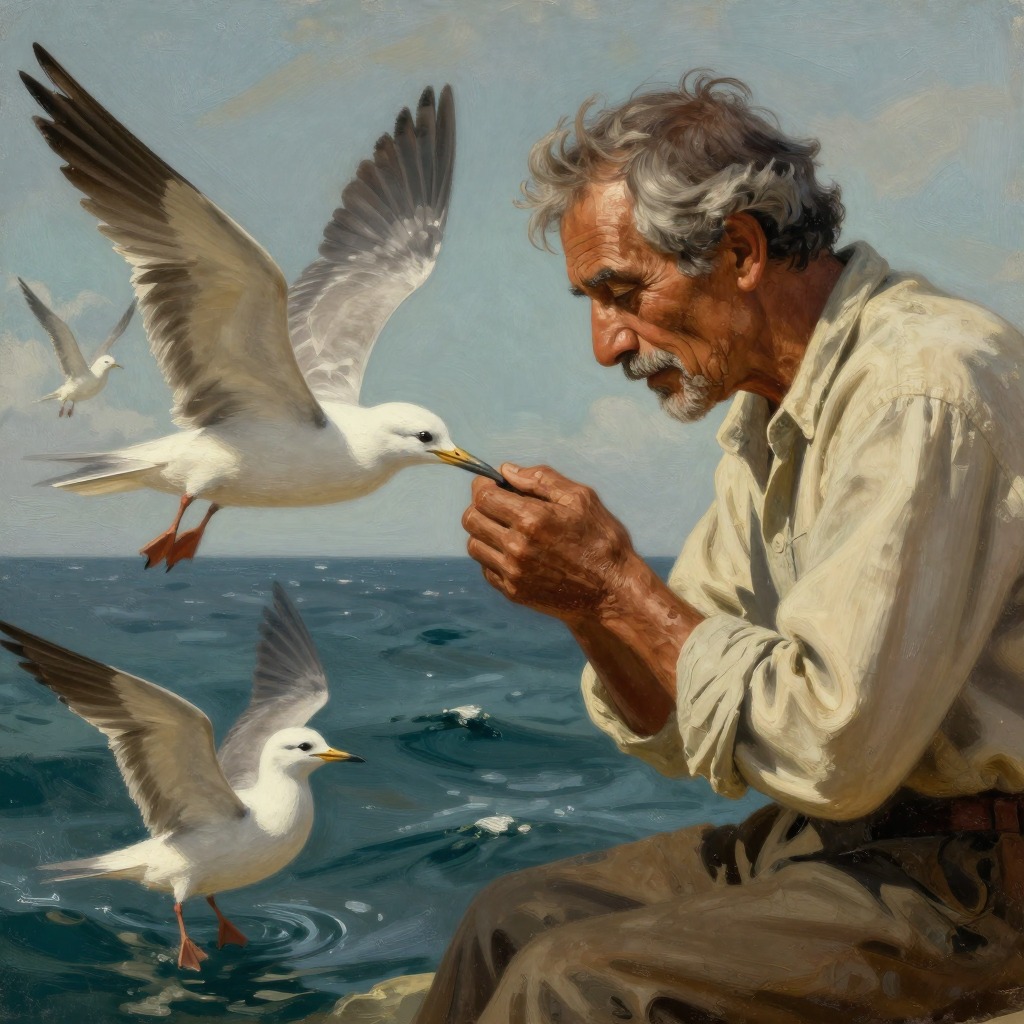
Man-of-war bird
The Man-of-war bird, a long-winged black frigate bird, appears as a recurring figure in Santiago's solitary voyage, serving as both a practical guide to finding fish and a symbol of the relentless, often futile, struggle for survival in the natural world. Its presence marks key moments in the old man's quest, from the initial discovery of prey to the final, exhausted return, and its behavior offers a stark contrast to the old man's own endurance and skill.
Appearance and Role as a Guide
Santiago first spots the Man-of-war bird with his "long black wings circling in the sky ahead of him." The old man immediately interprets the bird's behavior as a sign of fish, noting aloud, "He's got something. He's not just looking." He rows toward the bird, trusting its instincts, and observes it make a "quick drop, slanting down on his back-swept wings, and then circle again." The bird leads him to a school of dolphin, and Santiago, shipping his oars, prepares his lines. Later, the bird is again seen working "low over the water," dipping and swinging its wings "wildly and ineffectually" as it follows flying fish. Santiago acknowledges the bird's utility, stating, "The bird is a great help." The bird's actions directly lead to the old man hooking an albacore, which he will later use as bait for the great marlin.
The Bird's Futility and the Old Man's Observation
Despite its role as a guide, the Man-of-war bird is also a figure of futility. Santiago watches as the bird repeatedly dives after flying fish, but the fish are "too big for him and they go too fast." The bird's movements are described as "ineffectual," and the old man notes that the school of dolphin has "gotten away from me" and that the bird "has no chance." This observation underscores the harsh realities of the ocean, where even a skilled predator can fail. The bird's struggle mirrors Santiago's own, as both are engaged in a constant, often unsuccessful, hunt for sustenance. The old man's empathy for the bird is evident in his earlier thoughts about the delicate sea swallows, which he considers "made too delicately for the sea." The Man-of-war bird, though a "robber bird" and one of the "heavy strong ones," is still subject to the ocean's cruelty.
The Bird as a Contrast to Santiago's Skill
The Man-of-war bird's instinctual, yet often futile, efforts highlight Santiago's own superior skill and understanding. While the bird can only react to the surface signs of fish, Santiago interprets the deeper patterns of the sea. He knows that the bird's presence indicates a school of dolphin, but he also understands that the school is moving "too fast and too far" for him to intercept. He does not simply follow the bird blindly; he uses its information to make calculated decisions about his own fishing. The bird's "ineffectual movements" contrast with Santiago's precise and deliberate actions, such as when he "shipped his oars and brought a small line from under the bow" to bait a hook. The bird is a tool of nature, while Santiago is a craftsman who uses nature's signs to his own ends.
The Bird's Disappearance and the Old Man's Isolation
The Man-of-war bird eventually disappears from the narrative, its role as a guide concluded. Santiago notes that "the bird was almost out of sight now," and later, after the marlin is hooked and the sharks begin their attacks, he observes that he "could not even see a bird." The bird's absence marks the old man's complete isolation in his struggle. No longer are there external signs or guides; he is alone with the fish and his own resources. The bird's departure also signals a shift in the narrative from the hopeful pursuit of prey to the grim battle for survival against the sharks. The old man's world contracts to the skiff, the marlin, and the relentless predators, with no friendly bird to offer even the illusion of companionship or guidance.